
WAR MAKES NO SENSE
UNLESS YOU READ THESE 5 BOOKS

When we understand the world as it is instead of as we wish it to be, we know that war is both permanent and universal. Every living creature on earth is engaged in defensive or offensive war from the smallest to the largest.
While snorkeling over a reef on the Atlantic side of the Panama Canal and seeing the flashing beauty of the multiple fish species below me, I knew that besides beauty I was looking upon a carnage house where all fish had to eat and sixty percent ate other fish.
Even the large herbivores that roam the dry land must defend themselves against predators who live off blood and meat. And all males of every species must regularly fight to the death (if necessary) for the right to mate.
Indeed, to my own tastes the only pleasant thing to observe in nature is the mothers and their off-spring, and even that is often a harrowing experience as the mother must defend her young from predators, and sometimes even males of her own species.
Among humans, we can only go by the stories we learn from history and personal experience. According to the story, in the first family one brother ambushed and murdered another brother in a rage over religious questions.
In history, humans are not just family members but participants in cultures locked in existential struggle. The culture that wins is the one that presses its identity onto the earth through aggression and holds it through defense. The rest go extinct — like the Hittites, Amalekites, Moabites, Carthaginians, and Romans.
I have always tried to live in the world as it is and to keep the peace, but I have never believed the peace would last. That is what being a realist means. I was born during World War II. Because my father used his GI Bill, I essentially began college at the age of four — not as a student, but living on the University of Oklahoma campus, surrounded by returning GIs. From 1946 to 1950 the school was overwhelmed by these battle-tested men. It was probably the best four years in the university’s history to be there: the campus belonged to grown men, not boys. I admired them to the depths of my soul.
On the other hand, like many other young liberals when I was growing up, the thought that I would ever wear a uniform couldn’t have been further from my mind. But I did read two war books in the 6th grade. Mr. Miller, a captain in the artillery whose landing craft was sunk out from under him on D-Day, 1944, had gone to the Salvation Army and purchased seventy or 80 books for our class library.
I found in that treasure two war books. The first was Old Soldiers Never Die by Frank Richards (real name Francis Philip Woodruff, 1883–1961). He was a working class enlisted man who survived in the trenches all the four years of the First World War. The book in the library was an old and ragged first edition from 1933. The text was graphically vivid without pictures. I have read many books describing trench warfare from 1914 to 1918, but never one that made a greater impression on me.
The second book was God Is My Co-Pilot by Robert Lee Scott, Jr., later a brigadier general.
I learned from that book that Claire Lee Chennault who commanded the Flying Tiger volunteers in China before Pearl Harbor, ordered his fliers never to dog fight with the Japanese Zero, but to get above them, dive through them guns blazing, and fly away — a rule the first navy pilots who later tangled with the Zero in the Pacific had to learn on their own.
I also liked the book and purchased it often to give as a present to young men, in the vain hope that they would read it.
Unfortunately, deep reading as food for the inquiring mind has almost gone the way of the carrier pigeon. The long decline started with television and was essentially finished by the personal computer and smartphone.
But now war with Iran has erupted, and we have gone all in. We may find we cannot easily let go — like grabbing the tail of a tiger. Or worse, it may become a quagmire that demands years of blood, time, and treasure before any tolerable outcome is possible. Regardless, the conflict gives me an excuse to share five of my favorite books of personal memoirs and battle histories from World War II.
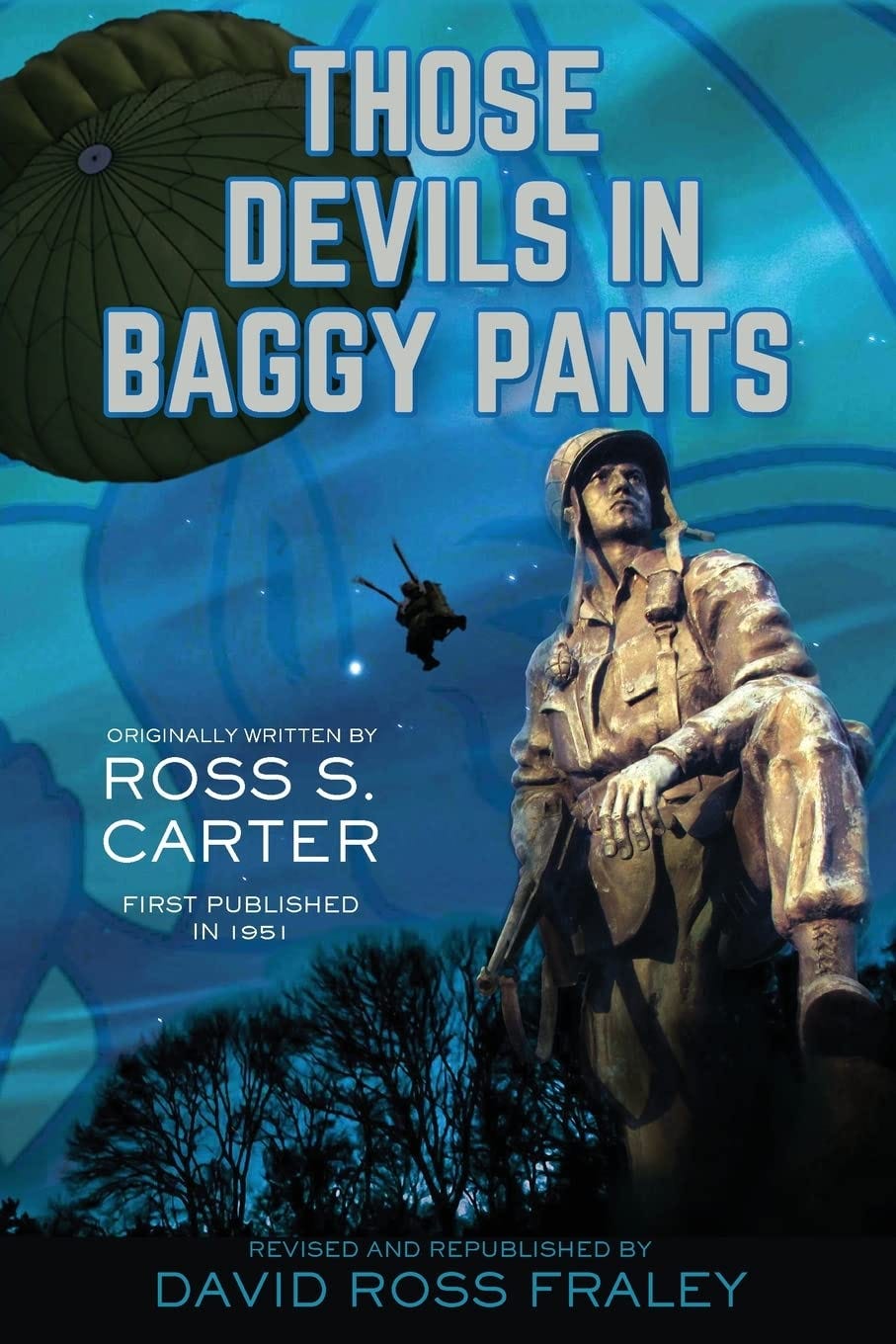
I first read this book as a young teenager. It is a powerful WWII memoir by Ross S. Carter, a paratrooper with the 82nd Airborne Division’s 504th Parachute Infantry Regiment. Carter wrote it from memory in the months after the war, but he died of cancer in 1947. His family had the book published four years later in 1951.
In the early chapters—covering training and North Africa—the writing feels like that of a college sophomore recounting the hijinks and adventures of young men in an airborne platoon. The “cast” is vivid: three infantry squads of twelve men each, plus a headquarters section. Then they jump into Sicily, and the real combat begins.
One by one, the characters are killed or wounded so badly they vanish from the story. What starts as a straightforward combat diary—from Sicily through Italy, France, and into Germany—gradually rises to the level of Greek tragedy. By the end, three survivors remain from the original 40-man platoon. I’ve read the book three times, and each time I feel the same deepening sorrow and desperation as the pages turn and the ranks thin.
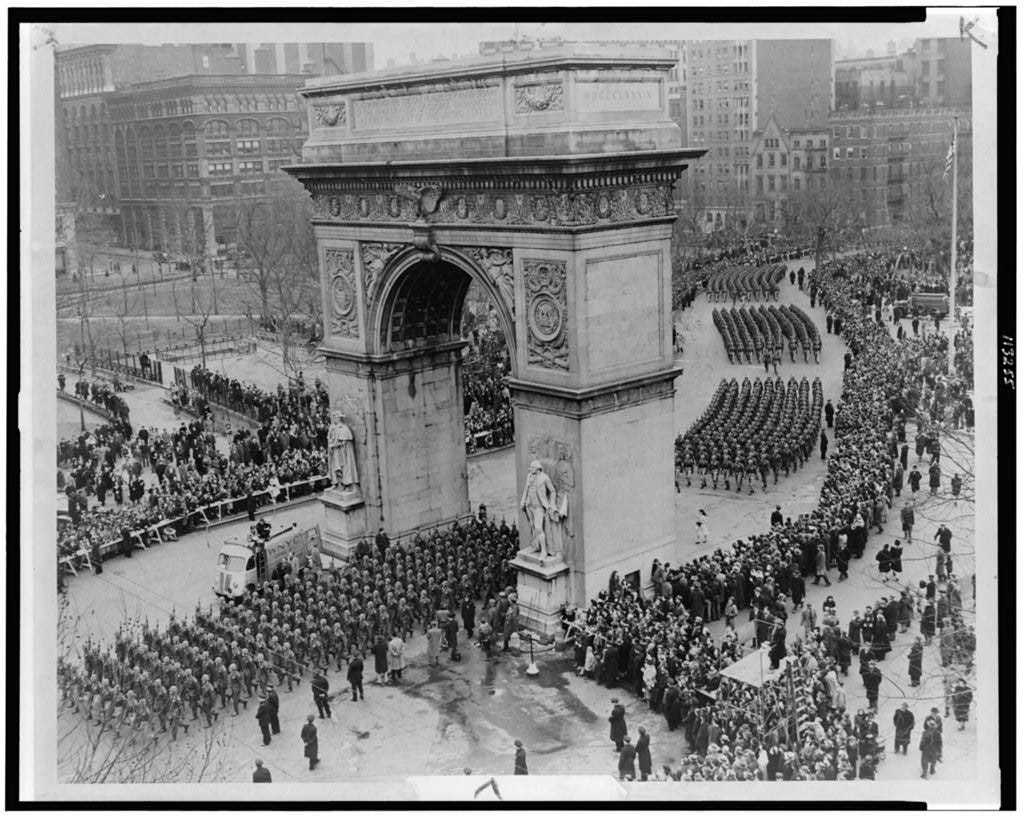
There is a remarkable YouTube video of the 82nd Airborne Division marching down Broadway in New York City during their victory parade after World War II. Nothing else quite captures the essence of a tough American infantry division returning from war like that parade. The sight of those battle-hardened men moving with that precise, uniform stride— in perfect formation—is both awe-inspiring and intimidating: a living reminder of disciplined strength that would unnerve any enemy and still unsettles the modern sensibility.
Ross S. Carter was one of those marching men.
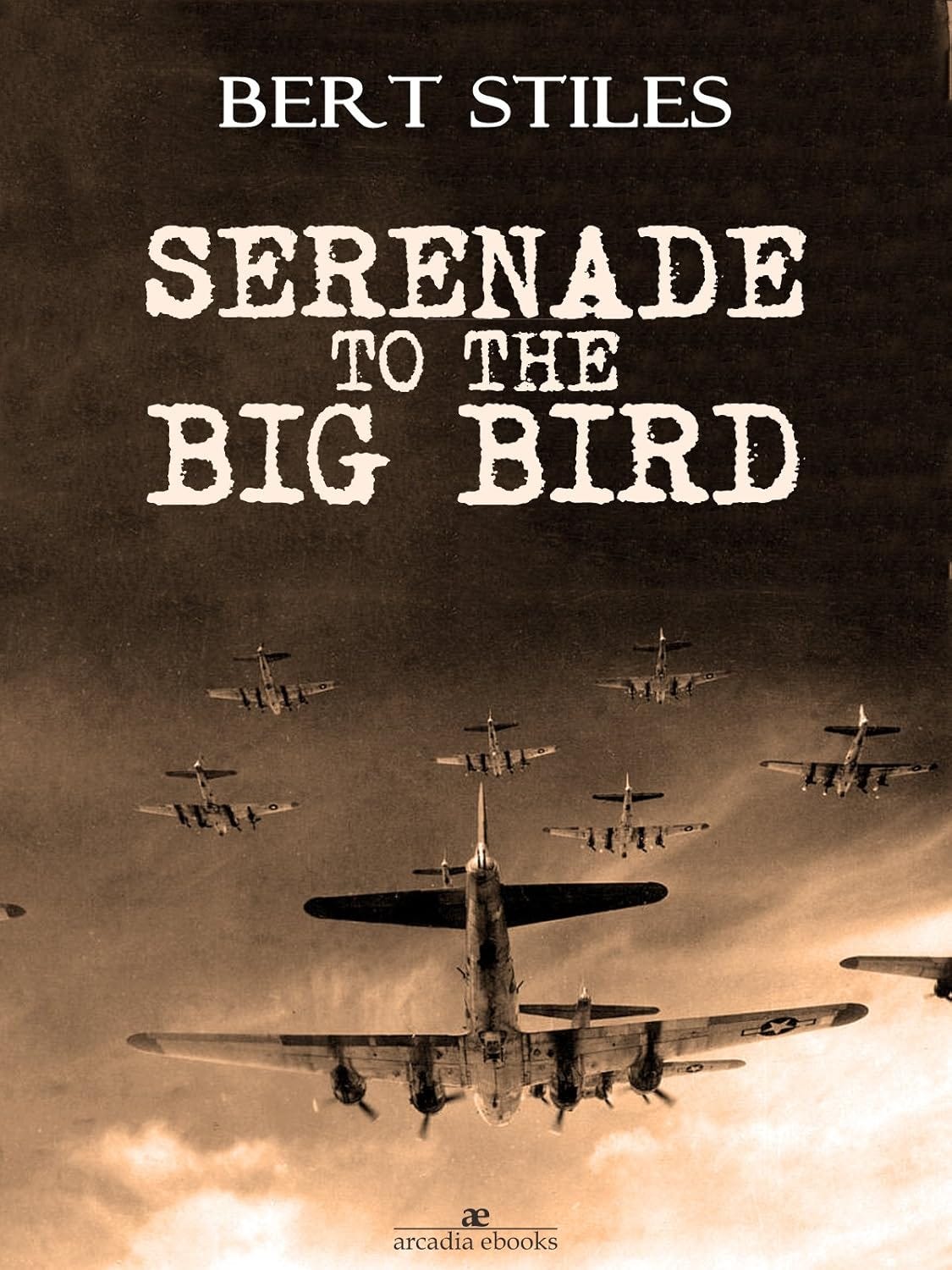
I first encountered an excerpt from Bert Stiles’ Serenade to the Big Bird in a freshman anthology at Baylor University in the fall of 1962. I was so struck by it that I immediately read the entire book — and I have returned to it several times since. Even now, the opening page still moves me: a simple, stark list of the B-17 crew members by name.
He described in Hemingwayesque prose his 35 missions for the 401st Bomb Squadron, 91st Bomb Group as a copilot on a B-17 over Germany beginning in March 1944.
By 1944–45, a bomber crewman in the Eighth Air Force had a 66% probability of surviving a 35-mission tour. Still, the Eighth lost more than 26,000 airmen killed in action—more than the entire U.S. Marine Corps losses in the Pacific (roughly 24,500).
Unexpected, isn’t it? We imagine Marines in the pit of hell on blood-soaked islands, while bomber crews fought high above it all.
Stiles describes the contrast from the aircrew’s perspective. In a sense, pilots and crew members lived surrounded by many comforts of home. They slept in warm beds, ate hot meals, and, while on pass, had access to the amenities of wartime civilian life.
Their greater burden was the diurnal cycle of existence. After landing safely on their home field the previous afternoon, they would leave those comforts before dawn and fly directly into layered belts of death—German 88s firing from the ground, Focke‑Wulf 190s and Messerschmitt 109s diving from the stratosphere, and a German finger poised on every trigger from earth to sky.
Stiles was an FDR liberal. He wrote dreamily of ending war and how education was the nation and the world’s great hope.
But he didn’t know when to quit. Finishing his 35 missions in a B-17, he asked to fly P-51s and was killed on an early mission chasing a German plane to the ground and unable to pull out.
He was 23 years old.
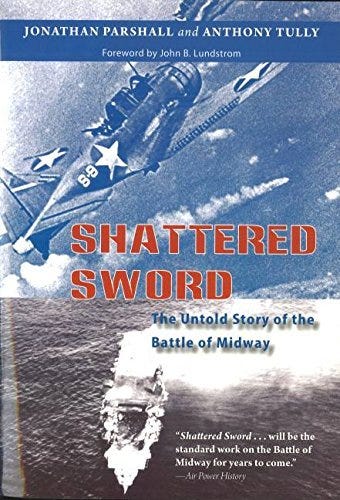
Shattered Sword: The Untold Story of the Battle of Midway (published in 2005 by Potomac Books). Jonathan Parshall (sometimes referred to as Jon Parshall) and Anthony Tully (or Anthony P. Tully).
This is straight history with a punch, but not the emotional charge of the previous two books. The battle itself did not turn the war in the Pacific, but it stopped the Japanese. From Midway on, America had the initiative, and the Japanese had no hope of regaining it.
Parshall and Tully are both serious Pacific War and naval wonks whose explicit goal in Shattered Sword was to clarify and straighten out the many kinks, myths, and inaccuracies that had accumulated around the Battle of Midway over the decades. And there’s nothing wrong with being a wonk. My own goal is simply to rise to the level of an apprentice wonk.
The authors possessed both the mastery of the Japanese language and deep access to original Japanese documents, allowing them to reconstruct the battle’s true flow and foibles with unprecedented clarity.
I have recommended Shattered Sword constantly, given away multiple copies, and read it at least twice — a clear and well-written history.
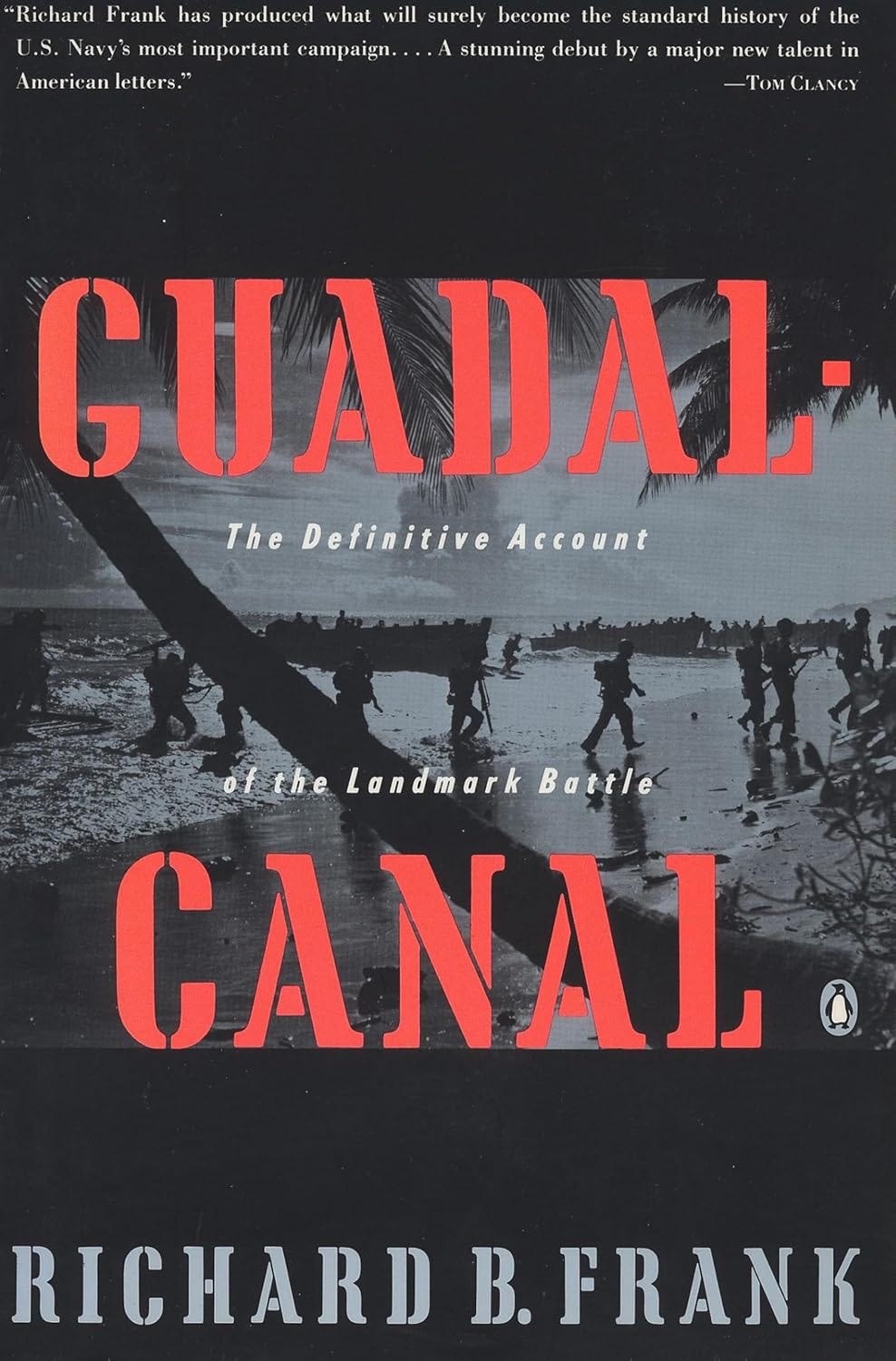
Richard B. Frank’s Guadalcanal: The Definitive Account of the Landmark Battle was released in hardcover on November 27, 1990, by Random House. At roughly 800 pages, it remains a true mega-book by modern standards.
I’ve tried for years to interest ambitious students or any of my own sons in reading it, but without success. Sadly, it will almost certainly never appear as an audiobook, and while a paperback edition came out in 1992, the work has long been out of print in any easily accessible new edition.
Everything related to the battle is there — land, sea, and air. Frank’s prose is clear and highly readable, and he delivers a comprehensive account of what was arguably the most important battle of the Pacific War. When the fighting on Guadalcanal finally ended in early 1943, Japan had clearly lost the war — even though thousands of miles of ocean still lay ahead and tens of thousands more men, women, and children would have to die before Tokyo finally conceded defeat.
A genuine interest in the Pacific War is best satisfied by beginning with Richard B. Frank’s Guadalcanal.
The Marines — the gyrenes — lived in a special kind of hell. They fought in a world of endless muck where every flying and crawling insect seemed to live off the blood sucked from human flesh, and dysentery was issued to each man along with his mess card.
Approximately 1,152 to 1,353 Marines were killed on or around Guadalcanal. In contrast approximately 4,900 to 5,000 sailors died in the series of naval engagements in the waters off Guadalcanal.
The Marines can’t win the casualty argument, even when they lose it. We naturally feel greater sympathy for the infantry because of the sheer misery of their daily existence and the intimate, brutal nature of their deaths. A sailor standing behind three inches of armor plating may be moments from being blown to kingdom come, but he can still draw some faint comfort from that steel. A pilot or bomber crewman flies through thin air armed with multiple machine guns, shielded by cockpit armor and the ability to maneuver violently to dodge death.
But the Marine sleeps in the mud, walks through a jungle where firefights can erupt at five yards, carries “food” in his pack that a dog would refuse, and treats necessities like washing as distant memories. Sleep itself becomes the most dangerous time — the hour when his throat is most likely to be slit. None of us can truly imagine ourselves in his place.
In 1965 I was an infantryman, carrying the 11B MOS (military operational specialty). My sympathy lies with the Marines.
Frank’s book is where I first made acquaintance with the 1st Marine Division and its commanding officer on Guadalcanal, Major General Alexander Archer Vandegrift.
I will say this now, and I may say it again later, because the remaining book on this list draws from the 1st Marine Division: Where do these men come from? And why does God bless us with such great generals?
I love Navy stories and I love Air Force stories, but most of all I love infantry stories. All three elements are wonderfully covered in Frank’s Guadalcanal book — land, sea, and air — yet it is the infantry that moves me the most. The gyrenes of the 1st Marine Division, fighting in that green hell under Vandegrift’s steady command, embody something raw and profound that no other branch quite captures.
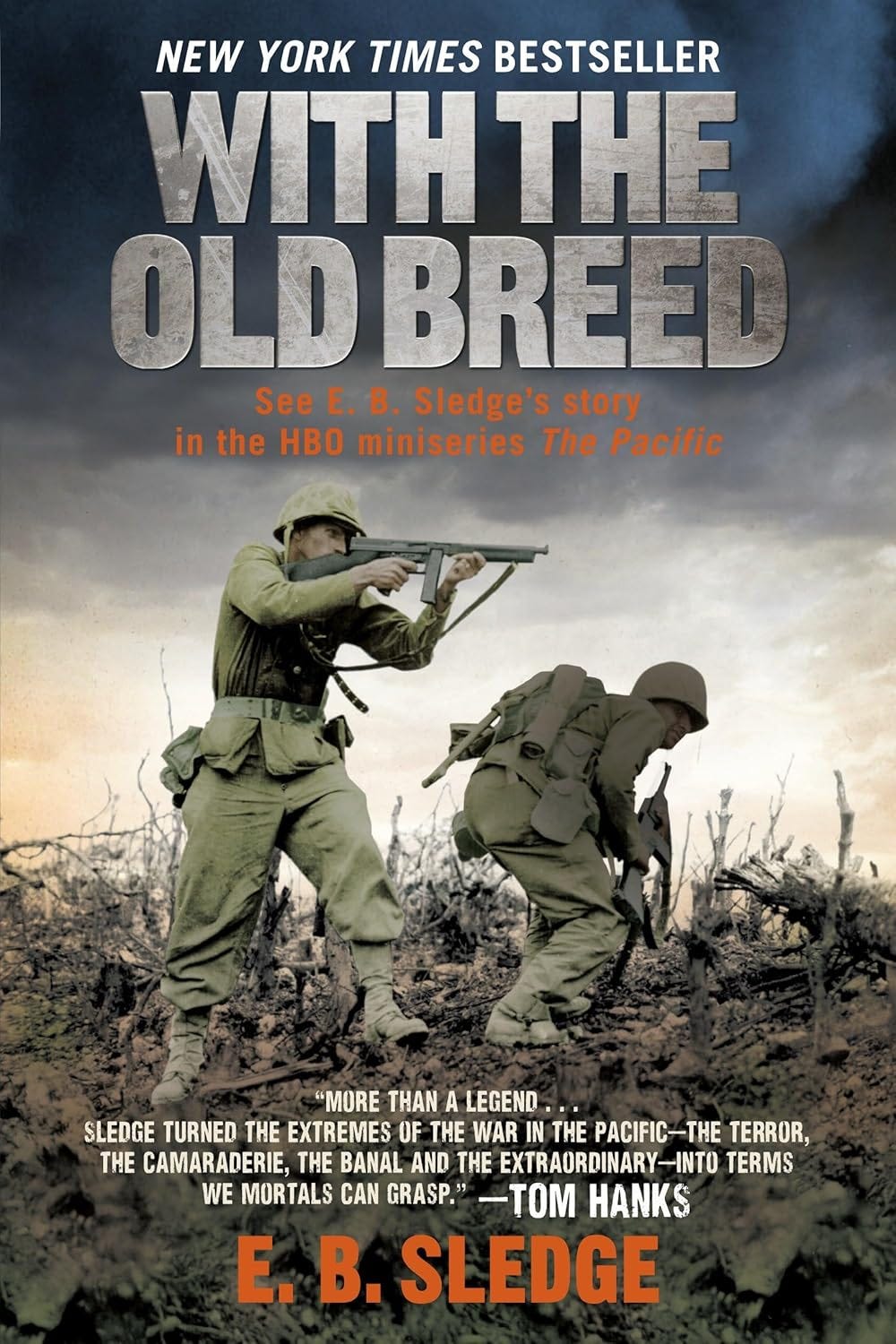
Eugene B. Sledge had just turned nineteen when he entered the Marine Corps in late 1942. A skinny kid of five feet eight inches and 135 pounds, he became a 60mm mortarman with K/3/5 of the 1st Marine Division. By the time the war ended on Okinawa, he weighed much less — worn down by months of brutal combat, rain, and starvation rations.
He disobeyed orders and kept a diary in a copy of the New Testament describing his Marine Corps life in two major battles on the islands of Peleliu and Okinawa — Two of the fiercest battles in the Pacific war.
Only in his late fifties did Sledge begin writing the memoir that would be published in 1981. With the Old Breed is universally praised as one of the greatest war memoirs to come out of the Second World War — and deservedly so. But it is not for the faint-hearted. Sledge was a mild-mannered, likable man, the kind of biology professor students remember fondly. Precisely because he was so decent and restrained, his matter-of-fact accounts of shattered bodies, corpse mutilation, and the cold precision required amid total chaos strike with brutal force.
So many veterans stay quiet about their war experience because in every aspect it is too awful to describe.
I have often meditated on what it takes for a normal, peace-loving civilian to become a raging killer in the kind of close quarters fight where men claw at each other with bayonets and entrenching tools at the bottom of a foxhole. I doubt anyone has truly described it. No mother could read it without coming undone.
Sledge comes closest. Through his quiet, unflinching prose, the reader feels the war, smells the war, and lives inside it with all its crushing weight. Above all, you grasp what so few accounts convey: the veteran comes home forever carrying an enormous, unresolved burden — guilt, grief, and the constant, gnawing terror of what might have happened.
Sledge describes a complete breakdown on a post-war hunting trip. He never hunted again. And he lived out his life as a biology professor, a husband, and the father of two children.
NOTE:
MY NEW NOVELLA, THE DEATH OF SERGEANT YORK, IS AVAILABLE ON AMAZON NOW!
This Substack is edited by Titus Gee